
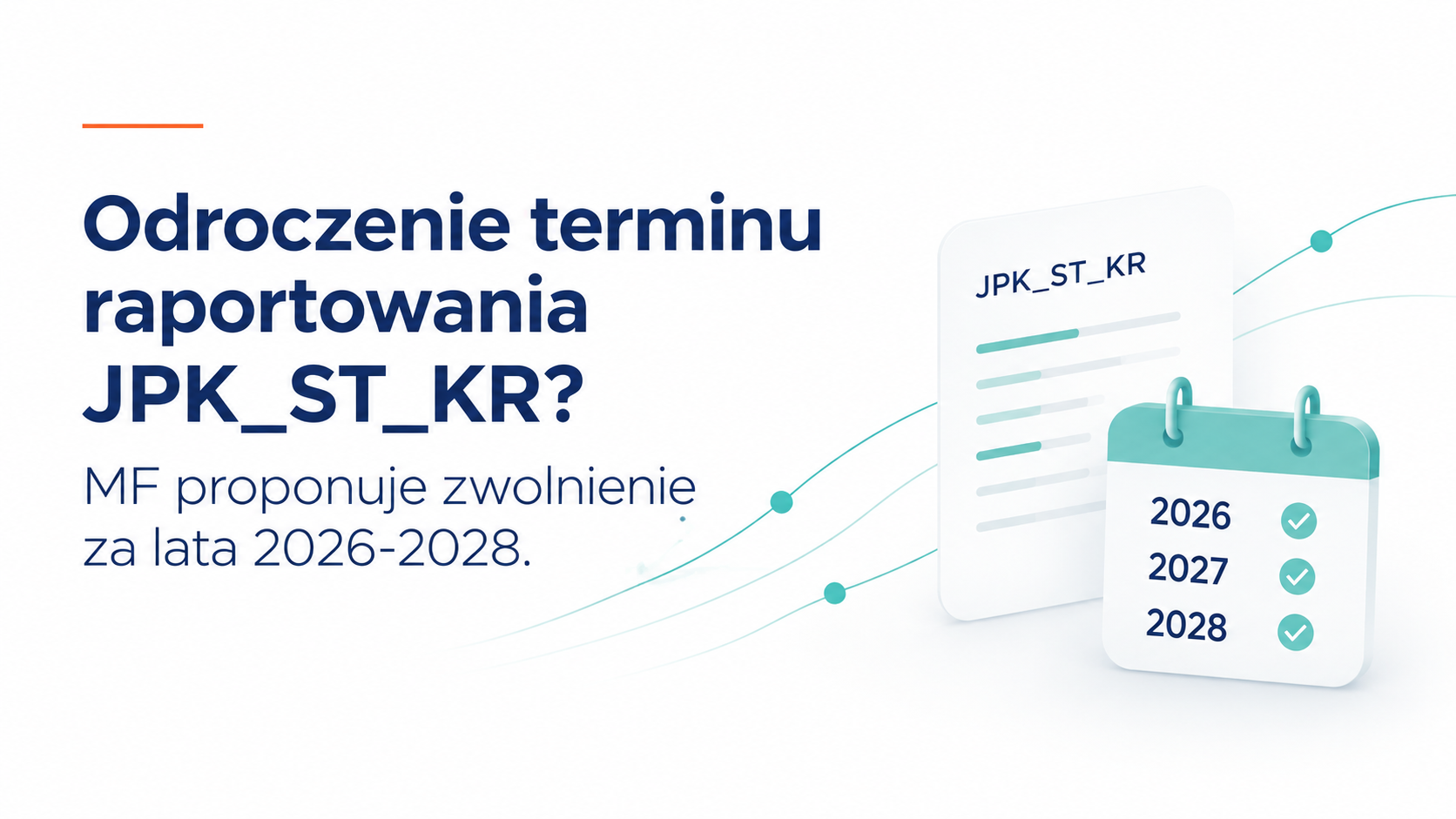
Postponement of the JPK_ST_KR reporting deadline? The Ministry of Finance proposes exemption for 2026-2028.
Companies preparing for JPK_ST_KR reporting may receive more time to adapt their systems and organize fixed asset data. The Ministry of Finance and Economy has prepared a draft that assumes postponing the JPK_ST_KR reporting deadline.
The proposal concerns both the transmission of records in the JPK_ST_KR structure and their maintenance using computer programs based on the indicated provisions of the CIT Act. It does not cover JPK_KR_PD. For finance and IT teams, this means the possibility of changing the schedule of part of the implementation while maintaining preparations for accounting books reporting.
The article discusses the draft from August 10, 2026. The last confirmed state of legislative documentation is from September 2, 2026. The described exemption is a planned solution, and the draft itself does not constitute a basis for ceasing to fulfill these obligations.
Deferral of the JPK_ST_KR reporting deadline? in SAP
JPK_ST_KR is an XML structure used for electronic transmission of data from fixed assets and intangible assets records. According to the ministry's draft, the temporary exemption would cover two obligations: maintaining these records using computer programs and electronically transmitting them under Article 9(1c) of the CIT Act.
The addressees of these provisions are CIT taxpayers and non-legal entity companies subject to relevant obligations under the CIT Act. The Regulatory Impact Assessment also mentions tax capital groups. Applying the exemption would require considering the entity's status and scope of obligations each time.
The draft does not abolish the fixed assets records themselves nor the obligations related to amortization settlements. The company must still have data allowing correct determination of the initial value of assets, calculation of amortization write-offs, and consideration of events such as improvements, sales, or liquidation.
The exemption would therefore concern specific requirements for electronic maintenance and transmission of records. It would not mean abandoning asset documentation or control over the correctness of its settlement. This scope results from § 1 of the draft and its justification.
JPK_ST_KR from 2029 – for which years is the exemption to apply?
The draft provides for an exemption for tax years starting after December 31, 2025, and before January 1, 2029. For non-legal entity companies, the analogous rule applies to the financial year.
For a company whose fiscal year coincides with the calendar year, this would mean exemption for 2026, 2027, and 2028. The first year not covered by the proposed solution would be 2029, and data submission for that period would occur after its end.
For a fiscal year other than the calendar year, the decisive factor is its start date. For example, the period from July 1, 2028, to June 30, 2029, would fall within the exemption scope because it begins before January 1, 2029.
Therefore, the term “postponement of JPK_ST_KR until 2029” should be understood in relation to the periods subject to the obligation. It does not mean that all companies would send the file for the first time in 2029.
The current draft does not provide for later creation of reports for the years covered by the exemption either. It proposes exemption for the indicated periods, not postponing the submission of all these files to one later date.
The draft does not postpone JPK_KR_PD in SAP – preparations for reporting are ongoing
JPK_ST_KR and JPK_KR_PD concern different data scopes. The first structure covers the register of fixed assets and intangible assets. The second is used for reporting accounting books for income tax purposes. Both are described in materials of the Ministry of Finance concerning JPK in income taxes.
The discussed draft provides exemption only in the area of JPK_ST_KR. It does not change obligations related to JPK_KR_PD, so companies subject to reporting should continue preparing accounting data, assigning tags, mapping accounts, and verifying report correctness.
This distinction matters when deciding on the budget and implementation schedule. Postponing work on generating JPK_ST_KR does not necessarily mean that all tasks related to asset data can be deferred.
For example, organizing depreciation information may also be necessary for proper accounting book reporting. Before changing the project plan, the company should check which tasks concern only JPK_ST_KR and which also support JPK_KR_PD preparation.
Postponement of the JPK_ST_KR reporting deadline – legislative stage and planned entry into force
The draft regulation was sent for consultation by letter dated August 17, 2026. Participants were given 14 days to submit comments from the date of receipt. The latest update from September 2, 2026, in the published legislative process documentation indicates the public consultation stage.
Among the available responses are the positions of the Association of Accountants in Poland and the Zielona Góra Agreement. Both organizations did not submit comments. However, this does not mean the legislative process is complete or the regulation has been adopted.
The further path includes consideration of positions, completion of required arrangements and opinions, and determination of the final content. After appropriate legal and legislative verification, the act may be signed by the minister and then published in the Journal of Laws. The minister's regulation does not require adoption by the Sejm and Senate or the President's signature.
According to § 2 of the draft, the exemption would enter into force the day after the regulation is announced.
For enterprises, the basis for applying the exemption will therefore be the final content of the announced act and its entry into force. Until then, the draft can be used for planning possible schedule changes but does not replace binding regulations.
How to prepare the SAP system and data for JPK_ST_KR?
The ministry justifies the postponement proposal by reported problems with the availability of IT solutions enabling full and automatic fulfillment of JPK_ST_KR obligations. According to the regulatory impact assessment, difficulties concern both small entities and large enterprises using ERP systems.
For a company, this is a good starting point to assess its own reporting process. The mere possibility of generating an XML file does not yet confirm that the data contained therein are complete and correct.
A practical review should start with several sample asset components. Their history should be traced from the acquisition document and card file, through balance sheet and tax depreciation, to the information intended for JPK_ST_KR. In the SAP environment or other ERP, this allows recognizing whether the problem lies in system configuration, missing data, or data retrieval rules.
Based on this, further tasks can be determined:
- filling gaps in card files and historical data;
- explaining differences between balance sheet and tax records;
- agreeing with the system provider on the scope of changes and testing methods.
If the regulation is announced, the schedule should be adjusted to its final content and exemption periods applicable to the given company. Additional time will then allow spreading out work on JPK_ST_KR while maintaining tasks necessary for JPK_KR_PD fulfillment.
Preparing your company for JPK CIT? Talk to Haergi about data mapping, system requirements, and the reporting preparation plan.
JPK · JPK CIT